

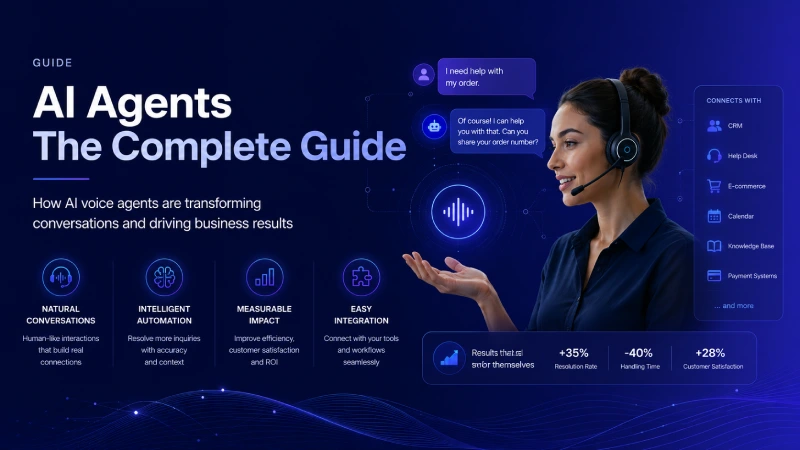
AI agents have evolved from lab concepts into real operational infrastructure for the world’s most competitive enterprises. Today, the question is no longer whether your company should deploy one, but rather which type to choose and how to implement it effectively.
This guide answers our most frequently asked client questions: **what exactly is an artificial intelligence agent**, how does it differ from a traditional chatbot, what types are available, how much can it truly automate, and how to take the first step without wasting resources.
of customer interactions can be fully automated with a well-implemented agent.
reduction in overall operational costs within customer service departments.
continuous availability with zero downtime, handling holiday traffic and peak spikes.
average response time compared to several minutes required for human support.
What is an AI agent?
An AI aagent is an autonomous artificial intelligence system capable of understanding a request, reasoning through options, making decisions, and executing actions within real-world business applications (CRMs, ERPs, messaging platforms) to achieve a specific goal—without requiring human intervention at every step.
The core keyword here is autonomy. An agent does not simply respond; it acts. It can query a database, update a record in your CRM, send a WhatsApp message, create a ticket in your service desk, or seamlessly escalate to a human agent when it detects a complex edge case, all within a single conversation flow.
This capacity for action completely sets it apart from previous generation tools, unlocking true end-to-end process automation for complex business operations.
Key concept
AI AgentA helpful analogy
If a traditional chatbot is like an automated interactive voice response (IVR) phone system with pre-recorded menus, an **AI agent** is like an expert employee who reads an incoming email, checks the internal database, makes the right decision, and directly executes the solution.
How artificial intelligence agents work
Under the hood, a modern enterprise AI agent combines multiple technological layers that work sequentially in real-time:
Large Language Model (LLM)
The cognitive core. It interprets user intent, generates internal reasoning, and autonomously determines which tool or action to execute next.
Contextual memory
Stores cross-session interaction history and user parameters to deliver highly coherent, personalized, and context-aware responses over time.
Integrated tools
Secure connections to external ecosystems: CRM, ERP, knowledge bases, and custom booking APIs. The agent calls them dynamically as needed.
Reasoning loops
The agent iterates: it acts, evaluates the response data, reasons again, and executes the next logical step until the goal is fully achieved or escalated.
Channel orchestrator
Manages multi-platform endpoints—Web, WhatsApp, Instagram, Voice—preserving full conversational context even if the user switches channels mid-session.
Guardrails & escalation
Enforces corporate safety criteria and deterministic thresholds that govern exactly when the system routes the session to a human supervisor.
Life Cycle
AutomationAnatomy of an interaction
User sends an input
LLM interprets intent
Agent evaluates tools
Queries or edits systems
Generates response
Awaits the next turn
Types of AI agents
Not all AI systems share the same architecture. Companies evaluate different categories of AI agents based on their core function, deployment channels, and degree of operational autonomy.
By core function:
Conversational agents
Engineered for real-time customer service, instant FAQ resolution, and omnichannel desk support. This remains the fastest path to immediate ROI.
Lead generation & sales agents
Qualify inbound traffic, address customer objections, pitch products, and smoothly guide prospects toward conversion or booking a live demo.
Operations management agents
Automate processing for reservations, orders, shipping updates, calendar adjustments, or secure changes requiring write-access to internal software.
Voice agents
Operate directly over phone systems with near-zero latency and natural turn-taking capability. Optimized for modern high-volume call centers.
By autonomy tier:
| Level | Agent Type | Core Capabilities | Enterprise Example |
|---|---|---|---|
| 1 | Reactive | Responds to immediate direct inputs without long-term contextual memory. | Basic FAQ bot |
| 2 | Memory-guided | Retains structured conversational data and context within a single active session. | Standard booking assistant |
| 3 | Tool-augmented | Queries, validates, and writes data to external third-party tools (via secure APIs). | CRM-integrated support agent |
| 4 | Planning-driven | Breaks down complex high-level business goals into sequential tasks and executes them. | Multi-step user onboarding agent |
| 5 | Multi-agent | Orchestrates, monitors, and cross-references multiple specialized sub-agents in parallel loops. | Enterprise agentic architecture |
Chatbots vs. AI agents
While confusing these two terms is incredibly common, understanding the distinction is vital when defining your automation technology investment strategy.
| Operational Metric | Traditional Chatbots | Autonomous AI Agents |
|---|---|---|
| Underlying logic | Rigid decision trees | Dynamic generative reasoning |
| Unexpected queries | Fails outside pre-programmed flows | Responds naturally with accurate context |
| System integration | Highly limited or isolated (static) | Native & bidirectional (read/write access) |
| Cross-session memory | No memory (completely forgets users) | Persistent and fully configurable context |
| Action execution | Only provides static links or routes | Acts autonomously (books, edits, syncs) |
| Smart escalation | Manual or rule-dependent routing | Semantic, transferring comprehensive logs |
| Maintenance cost | High (new paths require manual rebuilding) | Low (core cognitive engine generalizes tasks) |
The most important differences include:
- Underlying logic: A traditional chatbot relies on a rigid decision tree, whereas an AI agent uses dynamic generative reasoning. Handling unexpected queries: Chatbots fail outside pre-programmed paths, while agents answer naturally and accurately.
- System integration: Legacy chatbots feature limited or completely isolated integrations; modern AI agents provide native, bidirectional read/write synchronization.
- Cross-session memory: Chatbots maintain zero user recall; AI agents feature stable, persistent, and configurable context memory.
- Action execution: Chatbots can only display links or route requests; AI agents carry out tasks autonomously (such as booking, editing records, or updating platforms).
- Smart escalation: Legacy bots transfer sessions manually or via rudimentary rules; AI agents escalate semantically alongside the complete conversation transcript.
- Maintenance cost: Chatbots require continuous development for every new script; AI agents generalize effectively, drastically reducing upkeep hours.
B2B Strategy
Key Metric**Strategic takeaway:** If your company has already deployed an internal chatbot but your human support agents are still manually resolving **40% or more** of incoming conversations, it is a direct indicator that you need to shift to an autonomous **AI agent**, rather than dedicating valuable budget to restructuring a rigid rule-based framework.
AI agent use cases by industry
The versatility of enterprise AI agents makes them highly effective across almost every major vertical. Here are the core sectors experiencing the highest measurable operational impact:
Travel & hospitality
Handling 24/7 autonomous bookings, resolving detailed room availability queries, driving ancillary upselling, and executing post-stay follow-up workflows.
Utilities & energy
Managing immediate incident logging, executing plan modifications, processing smart meter readings, and running intelligent technical triage before escalation.
eCommerce & retail
Providing real-time parcel and order tracking, managing returns protocols, serving personalized recommendations, and running abandoned cart recovery paths.
Airlines & logistics
Processing flight updates, automating baggage tracing workflows, dispatching delay alerts, and managing self-service upgrades or seat choices within internal systems.
Healthcare & medical services
Automating clinical appointments, sending medication alerts, performing initial systemic symptom triage, and enabling secure access to medical profiles.
Banking & finance
Resolving real-time balance requests, processing immediate security card blocks, sharing targeted product sheets, and streamlining client onboarding paths.
Interactive assessment: Which AI agent architecture does your enterprise need?
Answer these 3 strategic questions and we will identify which agentic architecture solution aligns best with your operations.
Question .01 of .03
What is your biggest operational bottleneck right now?
Question .02 of .03
Which channel does your user demographic use most frequently?
Question .03 of .03
What is your organization’s current integration environment tier?
Recommended Blueprint
How to implement an AI agent step by step
Deploying a corporate AI agent goes far beyond selecting a technology provider. It is a structured strategic framework that, when handled correctly, yields clear operational improvements within weeks rather than fiscal quarters.
Implementation Framework
Milestones for secure orchestration
Identify high-impact use cases
Audit your customer interaction channels to pick workflows that feature repetitive steps and a high volume of requests (e.g., standard ticket intake, parameter modification, FAQ resolution).
Knowledge base & prompt optimization
Structure documentation, corporate manuals, and API registries to feed your system. Define operational rules, tones, and boundaries using strict alignment engineering.
Secure infrastructure integration
Connect the system directly to your tech stack (CRM, internal software dashboards, messaging channels) via secure communication keys, setting clear parameters for automated write actions.
Staging checks & pilot testing
Run interaction loops in a closed environment to monitor task precision and safety limits. Validate that fallback paths route sessions smoothly to support personnel.
Production launch & continuous tracking
Deploy to active customer-facing layers. Monitor success rates, user ratings, and conversation logs to run continuous fine-tuning loops.