
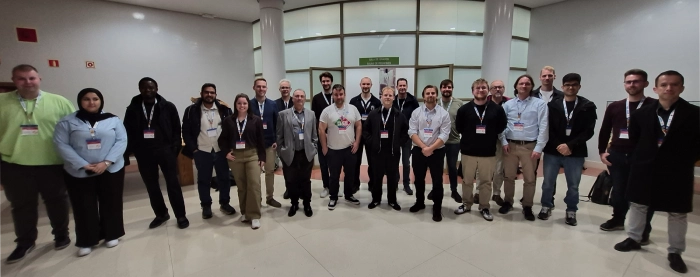
On 26 October 2026, Alcalá de Henares (Madrid, Spain) hosted the 4S-Net workshop, held as part of the 22nd International Conference on Network and Service Management (CNSM 2026), one of the world’s leading conferences on network and service management.
The International Workshop on Emerging Trade-offs in Networking: Sovereignty, Security, ReSilience, and Sustainability (4S-Net) is a specialist international forum that examines the challenges and trade-offs facing future communications networks, particularly in areas such as digital sovereignty, cybersecurity, resilience and sustainability.
The event brought together researchers, universities, technology centres and companies to present advances in key technologies for future 6G infrastructure, AI applied to networks and the protection of critical communications systems.
SafeRoute-6G project: key advances in cybersecurity for connected mobility
Aunoa was one of the speakers at the 4S-Net Workshop, where it presented the progress of the European SafeRoute-6G project on cybersecurity for vehicle-to-infrastructure (V2X) communications. In his talk, Teo Redondo, Head of Innovation at Aunoa, presented the paper “Adaptive SASE-Driven Cybersecurity for V2X Communications in 6G Networks: Architecture and Preliminary Results from the SafeRoute-6G Project”, which set out the first results of the adaptive security architecture designed to detect, classify and mitigate cyber threats in connected mobility environments over 6G networks.
The work is part of SafeRoute-6G, an international initiative under Eureka Celtic-Next that brings together 23 partners from 8 countries to develop technologies that improve road safety and accelerate the roll-out of connected autonomous mobility. Within the consortium, Aunoa leads a use case focused on protecting V2X communications against cyberattacks through a complete chain of automated detection, classification and response.
Among the advances presented at the workshop was an AI-based system that can identify anomalous behaviour in vehicle-to-vehicle communications using only CPU resources, with no need for cloud infrastructure or GPU accelerators. Preliminary results show 97.4% validation accuracy in threat detection and operational autonomy that avoids human intervention in 98.7% of the cases analysed.
The architecture developed by Aunoa combines artificial intelligence capabilities, virtualised network security functions (SASE) and a digital twin that can simulate complex mobility scenarios. This environment makes it easier to generate synthetic data, validate security decisions and continuously train the detection models.
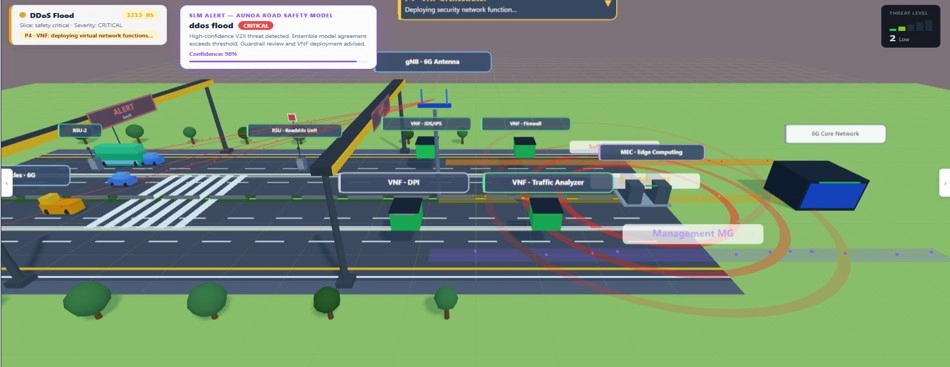
The SASE platform developed in the project was also presented as a simulation environment that can assess the threat level of each event and automatically trigger protective measures such as intrusion detection systems, firewalls or traffic analysers. Tests show average decision times of 44 milliseconds and an automatic resolution rate of 98.7%, results that are particularly relevant for critical connected and autonomous driving applications.
SUSTAINET project: sustainability, resilience and energy efficiency for advanced networks
Aunoa’s participation in CNSM 2026 also helped to strengthen international collaboration on other strategic projects the company is involved in. Coinciding with the conference, the partners in the European SUSTAINET project held a progress meeting to review activities and coordinate the next phases of work.
A Eureka Celtic-Next flagship project, SUSTAINET focuses on developing sustainable technologies for advanced, resilient and energy-efficient networks, adding automation, resilience and digital innovation capabilities to future communications infrastructure.
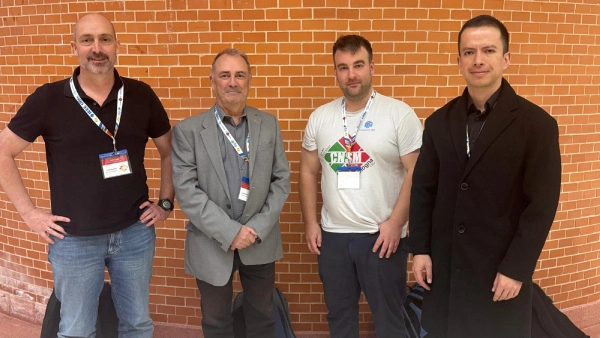
Aunoa strengthens its leadership in European projects
Aunoa’s participation in the international 4S-Net Workshop strengthens its position in AI applied to cybersecurity and smart mobility, as well as its role in European projects that aim to make future 6G networks safer, more resilient and more reliable for people, vehicles and connected infrastructure.
According to the conclusions presented by the research team, the results demonstrate that AI and automated protection mechanisms can be applied to respond to threats in V2X environments in real time, laying the foundations for future cybersecurity solutions in the era of connected mobility.